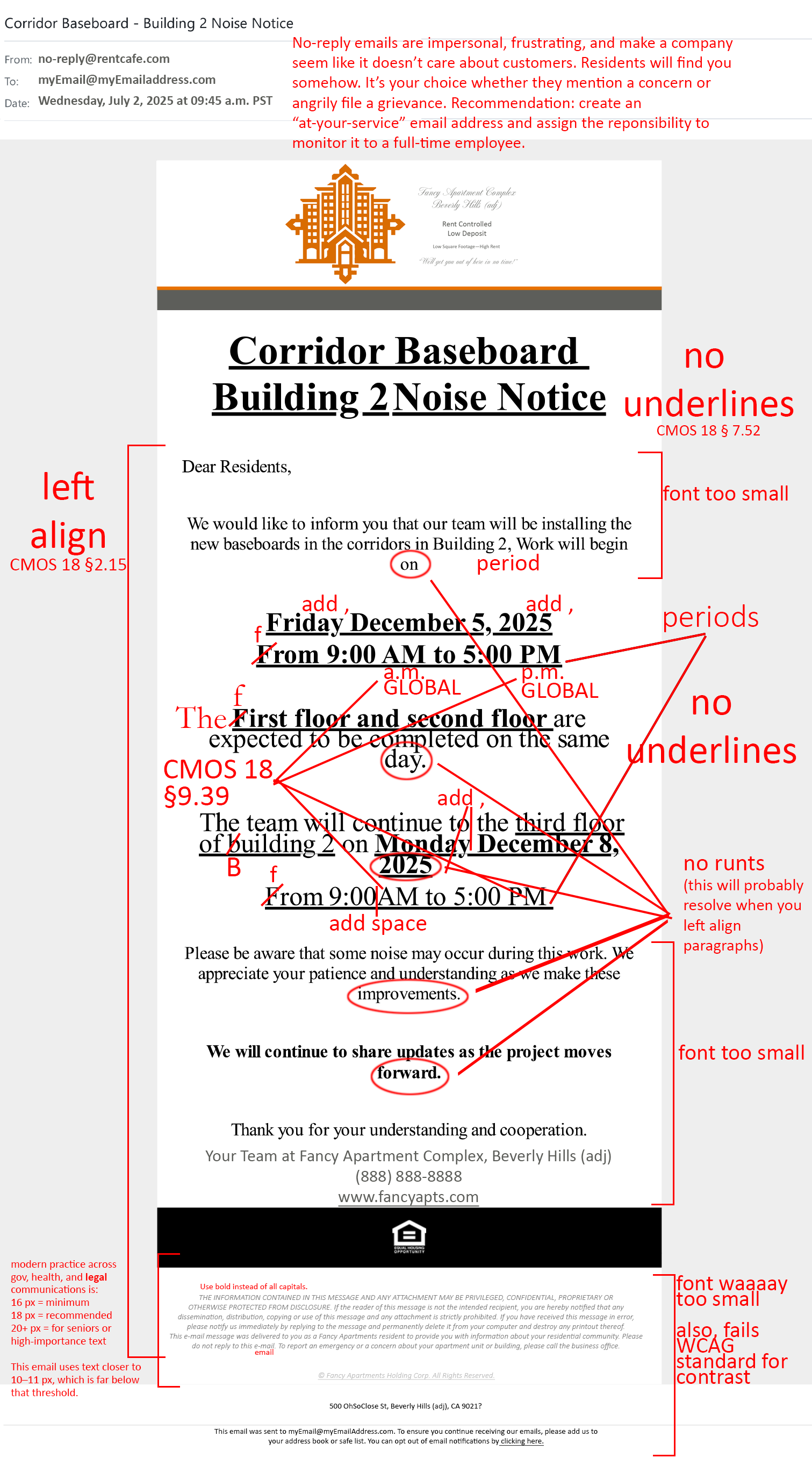
Some emails arrive so polished you feel grateful just to read them. And then there was the notice I received from my landlord.
I’ve de-identified it, and I’m sharing it here under the fair use doctrine of U.S. copyright law (17 U.S.C. §107). Consider it a teaching tool—a case study in how not to communicate with 100+ paying tenants.
If the landlord had sent this to me for proofreading, the first thing I’d say is: this needs two passes. Not because I enjoy charging people twice (though, let’s be honest, I don’t hate it), but because the formatting and consistency problems are severe enough that fixing them introduces a real risk of creating new errors.
For a clean document, my standard proofreading rate would apply.
397 words × $0.014/word = $5.56, with a normal two-day turnaround. That's less than two cans of soda and a bag of air with some chips from the laundry room vending machine.
But when a page lights up like a Christmas tree in red ink, I add a 50% surcharge, bringing the total to $8.34.
But they didn’t send it to me. So they saved themselves $5.56 (or, if we’re being generous, $8.34).
Penny wise and pound foolish
But did they really save anything?
Some tenants won’t notice any of this. They’ll skim the email, shrug, and assume this is just how corporate communication works now—half-formatted, half-hearted, and sent from a “no-reply” address that practically whispers please don’t talk to us.
Other tenants will notice, and they’ll chalk it up to the usual suspects: overworked staff, rushed timelines, or a workplace where proofreading is treated like an optional luxury instead of a basic courtesy. They won’t be angry. They’ll simply adjust their expectations downward—never a good direction for a luxury apartment brand.
And then there are the residents who actually read this stuff. They will spot the inconsistent capitalization, the runts, the underlining, the formatting issues, the font sizes that should come with a magnifying glass, and they’ll think something far more damaging than “oops.” They’ll think:
“If this is how carefully they write, how carefully do they handle everything else?”
In other words, this isn’t just a typo problem. It’s a trust problem. When your audience is renting expensive units in a building that prides itself on lifestyle, aesthetics, and service, the written communication becomes part of the product. Sloppiness isn’t free. It subtracts from the brand every time it hits an inbox.
And look—not everyone had great teachers, or supportive parents, or even parents who spoke English when they were kids. Some of us didn’t go to the right schools, and some of us had to figure out grammar from TV subtitles or the back of a box of cereal. That’s real life.
But when this kind of communication comes from adults in professional roles, questions arise. How strong are their pattern-recognition skills? If they saw that the formatting looked different in one place versus another, why didn’t they investigate? Did they choose not to learn? Do they choose not to check their work before sending it out into the world?
They can’t claim it takes too much time. And they can’t claim they lack resources—if they have a desk job, they have access to the internet. Proofreading tools, guides, tutorials, examples, even AI assistance are all a click away.
We expect more from people who claim to be professionals.
So yes, they saved $5.56.
But the impression they created? How much brand value did they throw away—for the price of a muffin from the hamburger stand on the corner, or roughly 83% of a beer at The Abbey (tip not included)?
Here is the marked-up document: